
You washed your car, dried it carefully, and stepped back — and it still looks dull. The paint seems flat, almost dusty. The color that used to pop now looks washed out. You might even notice a faint chalky residue when you run your hand across the hood.
That’s car paint oxidation. It’s one of the most common paint problems Massachusetts drivers deal with, and it gets significantly worse with every season it goes untreated. The good news is that for most vehicles, professional paint correction can restore your paint to a condition that looks better than it has in years — sometimes better than new.
Here’s everything you need to know about what car paint oxidation is, what causes it, how to recognize the different stages, and what your options are for fixing it.
What Is Car Paint Oxidation?
Oxidation is a chemical reaction. At a technical level, it occurs when oxygen molecules interact with the surface of your car’s clear coat and paint, breaking down the chemical bonds that give the paint its structure, color, and gloss.
Think of it like rust — which is itself a form of oxidation — but happening to your paint rather than the metal underneath. The oils and resins in your car’s paint and clear coat that create that smooth, glossy finish gradually break down. As they do, the surface becomes rough, porous, and dull. Colors fade. The surface takes on a chalky, hazy, or powdery appearance.
Left untreated long enough, oxidation doesn’t stop at the clear coat. It works its way into the base coat and — eventually — to the bare metal underneath, where it creates the conditions for rust to take hold. What starts as a cosmetic issue can become a structural one.
What Causes Car Paint Oxidation?
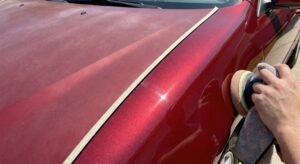
Several factors drive oxidation — and Massachusetts provides most of them in abundance.
UV radiation. Sunlight is the primary driver of paint oxidation. Ultraviolet rays break down the chemical bonds in your clear coat at a molecular level, degrading the protective layer that keeps your paint intact. Every hour your car sits in direct sunlight — whether driving or parked — accumulates UV damage. Even New England’s relatively moderate sun is more than enough to cause significant oxidation over the course of a few years on an unprotected vehicle.
Road salt. Massachusetts roads are heavily salted from November through March. Salt is highly corrosive — it accelerates the chemical reactions that break down your paint’s protective layers and dramatically speeds up the oxidation process. Every winter drive coats your car in a fine brine that sits on the paint surface and continues working long after you’ve parked.
Heat. High temperatures accelerate oxidation chemistry. A car parked in direct sun in July reaches interior temperatures well above 100°F — and the exterior surface temperatures are even higher. Heat speeds up the breakdown of the clear coat significantly.
Humidity and moisture. Water works its way into microscopic pores in the clear coat and accelerates the oxidation process from within. Coastal Massachusetts — with its high humidity, salt air, and frequent rain — provides constant moisture exposure that compounds the damage done by UV and road salt.
Air pollution and contaminants. Industrial fallout, exhaust particles, tree sap, bird droppings, and airborne pollutants all deposit on your car’s surface and chemically attack the clear coat. Bird droppings in particular contain uric acid that etches directly into clear coat within hours if left untreated.
Lack of protection. A vehicle that’s never waxed, sealed, or ceramic coated has nothing between its clear coat and all of the above. Protection doesn’t stop oxidation permanently, but it dramatically slows the process — giving your clear coat years of additional life.
Infrequent washing. Contaminants left on the paint surface — salt, pollution, organic matter — continue attacking the clear coat the entire time they sit there. Regular washing removes these contaminants before they can cause cumulative damage.
The Four Stages of Car Paint Oxidation
Oxidation progresses through distinct stages. Understanding which stage your vehicle is at determines what’s actually possible in terms of restoration.
Stage 1 — Light Oxidation
What it looks like: The paint appears slightly dull or hazy, especially in direct sunlight. The glossy, deep look it once had has faded somewhat. Color may look slightly less vibrant. Water no longer beads up cleanly on the surface after washing.
What it feels like: The surface may feel slightly less smooth than it used to, but there’s no obvious roughness or chalking.
Visibility: Most noticeable on dark-colored vehicles. White and silver cars can have Stage 1 oxidation that’s barely detectable visually.
What can be done: Light oxidation responds very well to professional paint correction. A 1-step or 2-step polish removes the oxidized material and restores full gloss and color depth. Results are dramatic and long-lasting when followed with a ceramic coating or quality sealant.
Stage 2 — Moderate Oxidation
What it looks like: Clear dullness and fading across multiple panels. The paint looks noticeably tired and aged. Some areas may show uneven color or a slight cloudiness. Swirl marks and surface defects are more visible because the clear coat has lost much of its depth.
What it feels like: The surface feels noticeably rougher than it should. Running your hand across the paint in sunlight may leave a faint chalky residue on your fingers.
Visibility: Clearly visible on all paint colors. Dark vehicles look particularly affected.
What can be done: Moderate oxidation requires a more aggressive paint correction approach — typically a 2-step process using a cutting compound followed by a finishing polish. Results are still very good and the paint can be fully restored in most cases. Professional correction followed by ceramic coating is the ideal outcome at this stage.
Stage 3 — Heavy Oxidation
What it looks like: Obvious chalking and fading. The paint looks significantly discolored — white and light-colored vehicles take on a yellowed or dingy appearance, while darker colors look almost grey. Chalky residue is clearly visible and transfers readily to anything that touches the surface.
What it feels like: Rough, gritty, and dry. The surface has completely lost its smooth feel.
Visibility: Unmistakable on any paint color. Vehicles at this stage often look decades older than they are.
What can be done: Heavy oxidation requires aggressive multi-stage correction, potentially including wet sanding on the most affected panels before compound work begins. Full restoration is possible in many cases, though some color depth and clarity may not be fully recoverable. Professional assessment is essential before any work begins — a skilled detailer will tell you honestly what results are achievable.
Stage 4 — Severe/Terminal Oxidation
What it looks like: The clear coat is visibly failing — cracking, peeling, or flaking in sections. The underlying base coat is exposed in places. The paint may have a milky, almost translucent appearance in affected areas.
What can be done: At this stage, paint correction alone cannot restore the finish. Once the clear coat has physically failed and begun to peel, polishing can only go so far — the compromised clear coat needs to be addressed at a body shop level, potentially requiring spot repairs or panel respray. We’ll always give you an honest assessment of what’s achievable vs. what requires body shop work.
How to Tell If Your Car Has Paint Oxidation
You don’t need special equipment to spot oxidation. Here are three quick tests:
The sunlight test. Take your car outside on a bright day and look at the paint at a low angle. Healthy paint shows deep, mirror-like reflections. Oxidized paint shows a hazy, flat, or patchy reflection that lacks depth.
The touch test. Run a clean hand across your hood or roof after washing. If you feel roughness or see a chalky white residue on your palm, oxidation is present.
The water bead test. After washing your car, watch how water behaves on the surface. On healthy, protected paint, water beads up into tight droplets and rolls off. On oxidized paint, water sheets across the surface in flat, spreading pools rather than beading up.
Why Massachusetts Accelerates Car Paint Oxidation
If you feel like your car’s paint ages faster than it should, you’re not imagining it. Massachusetts is genuinely one of the tougher environments in the country for automotive paint, for a few specific reasons:
Road salt season is long. Massachusetts salts roads from as early as October through as late as April. That’s up to 6 months of salt exposure every year — far more than most southern or western states.
Coastal salt air. The South Shore sits right on the Atlantic. Salt air attacks paint from above as well as below, creating oxidative stress even on days when the car isn’t driven.
Temperature swings. Massachusetts sees both extreme cold and genuine summer heat within the same calendar year. The expansion and contraction this causes in the clear coat accelerates its breakdown over time.
UV in summer. While Massachusetts winters are mild on UV, summer UV index readings regularly hit 7–9 in the Rockland area — well within the range that causes meaningful UV damage to unprotected paint.
How to Fix Oxidized Car Paint
The right approach depends entirely on the stage of oxidation your vehicle has reached.
For light to moderate oxidation: Professional paint correction is the solution. Using machine polishers and professional-grade compounds, a detailer removes the oxidized material from the clear coat surface and restores the underlying depth and gloss. The improvement is permanent — the oxidized material is removed, not covered up.
For heavy oxidation: More aggressive multi-stage correction, potentially including wet sanding, is required. This is a job for an experienced professional with paint thickness measurement equipment — removing too much clear coat causes irreversible damage.
For severe/terminal oxidation: Paint correction reaches its limits when the clear coat has physically failed. At this point, a body shop consultation is the right next step.
After any correction — protection is essential. A freshly corrected surface with no protection will begin re-oxidizing almost immediately. Applying a ceramic coating after paint correction creates a UV-blocking, chemically resistant barrier that dramatically slows the return of oxidation. It’s the single most effective step you can take to protect the investment of a professional restoration.
How to Prevent Car Paint Oxidation in Massachusetts
Prevention is always cheaper than restoration. Here’s what actually works:
Ceramic coating. The most effective protection available. Creates a hard, UV-resistant barrier over the clear coat that dramatically slows oxidation. A professionally applied ceramic coating can protect your paint for 3–7 years.
Regular washing. Removing salt, contaminants, and pollutants before they sit on the paint surface and cause cumulative damage is the single most impactful maintenance habit. Wash your car monthly at minimum — more frequently during and after winter.
Wax or paint sealant. If ceramic coating isn’t in the budget, a quality wax or synthetic paint sealant applied every 3–6 months creates a sacrificial protective layer over the clear coat. It doesn’t last as long as ceramic coating, but it’s far better than nothing.
Garage or covered parking. Eliminating UV exposure and reducing salt air contact by parking indoors or under a carport makes a significant difference over time — especially for vehicles parked in coastal areas.
Paint decontamination. Annual clay bar treatment removes bonded contaminants that regular washing can’t remove and that accelerate oxidation when left on the surface.
Professional Oxidation Removal at Massachusetts Car Detailing
At Massachusetts Car Detailing in Rockland, MA, we assess every vehicle’s paint before recommending a treatment. We use paint thickness gauges to understand exactly what we’re working with, and we give honest recommendations about what’s achievable — not just what sounds good.
Whether your car has early-stage dullness or significant chalking that’s been building for years, we’ll tell you exactly what we can do and what results you can realistically expect.
We serve Rockland and the entire South Shore including Weymouth, Hingham, Norwell, Hanover, Braintree, Scituate, Marshfield, and surrounding communities.
Book your paint restoration appointment today →
Frequently Asked Questions
Can oxidized car paint be fully restored? Light to moderate oxidation can typically be fully restored through professional paint correction — the results often look better than the car has in years. Heavy oxidation can be significantly improved but may not achieve 100% restoration depending on how deep the damage goes. Severe oxidation where the clear coat is physically failing requires a different approach. We assess every vehicle individually and give honest expectations before any work begins.
How long does paint correction for oxidation take? Depending on the vehicle size and severity of oxidation, professional correction takes anywhere from 4 hours for a light treatment to a full day or more for heavy multi-stage correction.
Does car wax fix oxidation? No. Wax adds a protective layer on top of the paint but does nothing to address the oxidized material underneath. Only mechanical correction — polishing and compounding — actually removes oxidation.
How do I stop oxidation from coming back after correction? Apply protection immediately after correction. A ceramic coating provides the longest-lasting UV barrier — 3 to 7 years depending on the product and maintenance. A quality paint sealant provides 6–12 months of protection. Regular washing and annual decontamination treatments help extend the life of whatever protection you apply.
Is paint oxidation the same as fading? They’re related but not identical. Fading refers specifically to color loss — UV breaks down the pigment molecules in the base coat, causing colors to become less vibrant. Oxidation refers to the broader breakdown of the clear coat and paint structure. Fading is often a symptom of advanced oxidation, particularly in vehicles without a clear coat (older vehicles) or those with failed clear coats.
My car has white chalky patches on some panels but not others — why? Oxidation progresses fastest on surfaces with the most direct sun exposure — horizontal surfaces like the hood, roof, and trunk lid typically oxidize before vertical panels like doors. South-facing panels also oxidize faster than north-facing ones. Uneven oxidation across a vehicle is completely normal and reflects differential UV exposure rather than a paint defect.
Massachusetts Car Detailing serves Rockland, MA and the South Shore. All paint correction and oxidation removal services are performed in our fully equipped shop at 320 Centre Ave, Rockland, MA.