
If your RV used to turn heads and now just looks tired, faded, and chalky — oxidation is almost certainly the culprit. It’s one of the most common problems RV owners face, and in Massachusetts, the combination of intense summer UV, coastal salt air, harsh winters, and temperature swings makes it happen faster than in most other states.
The good news: professional oxidation removal can restore your RV’s exterior to a condition that’s close to — or better than — what it looked like the day you bought it. At Massachusetts Car Detailing in Rockland, MA, we specialize in RV oxidation removal for fiberglass and gel coat surfaces, serving RV owners all across the South Shore.
What Is RV Oxidation?
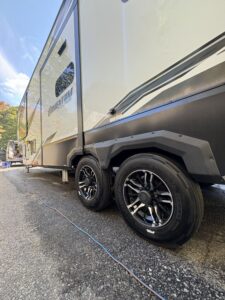
Oxidation is a chemical reaction that occurs when UV rays, oxygen, moisture, and environmental contaminants break down the protective gel coat on your RV’s exterior. Gel coat is the outermost layer of a fiberglass RV — it’s what gives a new RV that deep, glossy shine. Over time, without proper protection, that layer degrades.
When you see the signs of oxidation — chalky residue, dull or hazy surfaces, faded color, or a yellowish tint — what you’re actually seeing is the breakdown of your gel coat at a molecular level. Run your hand across a heavily oxidized RV panel and you’ll likely see a chalky white residue on your palm. That residue is deteriorated gel coat that has essentially turned to powder.
Left untreated, oxidation doesn’t just look bad. It progresses deeper into the gel coat and, eventually, into the fiberglass itself — leading to damage that no amount of polishing can reverse.
Why Massachusetts RVs Oxidize Faster
RV owners on the South Shore and throughout Massachusetts deal with some of the most challenging conditions for exterior surfaces in the country:
Coastal salt air. Salt accelerates the breakdown of protective coatings by speeding up the chemical reactions that cause oxidation. If your RV is stored or used anywhere near the coast — and most South Shore RVs are — this is a constant threat.
Harsh winters followed by intense summers. The freeze-thaw cycle causes the gel coat to expand and contract repeatedly. This gradually weakens the surface and opens it up to further UV and moisture damage once warmer weather arrives.
Road salt. Massachusetts roads are heavily salted from November through March. Every road trip exposes your RV’s exterior to a fine mist of corrosive brine that clings to the surface long after you’re home.
UV exposure. Even in New England, UV radiation is strong enough to break down unprotected gel coat in just a few seasons — especially on RVs that are stored outdoors without a cover.
Signs Your RV Has Oxidation
Not sure if what you’re seeing is oxidation? Here are the clearest indicators:
- The exterior surface looks chalky, hazy, or cloudy
- The original color appears faded or washed out
- White or cream panels have taken on a yellowish tint
- Running your hand across the surface leaves white residue on your fingers
- The finish looks flat rather than glossy, even after washing
- Certain panels look more faded than others (south-facing and roof panels oxidize fastest)
Mild oxidation is visible but still mostly surface-level. Moderate oxidation is more pervasive and requires more aggressive treatment. Severe oxidation involves deep chalking, significant yellowing, and may require wet sanding before any compound work can be effective.
The Professional RV Oxidation Removal Process
At Massachusetts Car Detailing, our RV oxidation removal follows a thorough, multi-step process designed to safely restore the gel coat without damaging the surface underneath.
Step 1 — Thorough wash and inspection. We start with a full wash to remove loose dirt, road grime, and surface contaminants. Then we inspect the entire exterior to assess the level of oxidation and identify any areas that need special attention.
Step 2 — Surface preparation. For moderate to severe oxidation, we may lightly sand problem areas using progressively finer grits to remove the topmost damaged layer of gel coat before compound work begins. This step requires experience — too aggressive and you can sand through the gel coat entirely.
Step 3 — Compound and oxidation removal. We apply professional-grade marine and RV compounds using a high-speed orbital polisher. The compound is worked in sections, breaking down and lifting the oxidized material from the surface. Multiple passes may be required for heavily oxidized areas.
Step 4 — Polish. After compounding, we follow with a fine polish to remove any micro-scratches left by the compound and to bring out depth and clarity in the gel coat.
Step 5 — Sealant or ceramic coating. The restored surface is then sealed with a protective wax, paint sealant, or ceramic coating to lock in the shine and create a barrier against future UV damage, salt, and moisture. Without this step, the gel coat will begin oxidizing again relatively quickly.
DIY vs. Professional RV Oxidation Removal
Mild oxidation can sometimes be treated with a quality marine-grade oxidation remover and some elbow grease. But there are real limits to what a DIY approach can accomplish — and real risks if you push past them.
Where DIY falls short:
- Moderate to severe oxidation requires machine polishing with the right compounds, pads, and technique. Hand application simply won’t cut deep enough.
- Wet sanding — sometimes necessary for heavy chalking or yellowing — is a high-risk technique. Done incorrectly, it removes too much gel coat and causes permanent damage.
- Consumer-grade products don’t match the cutting power of professional compounds, which means more effort for less result.
- RVs are large. Doing a full exterior properly takes many hours and significant physical effort. Rushing leads to uneven results.
When to call a professional:
- The oxidation is moderate to severe
- You’re seeing yellowing rather than just chalky haze
- Certain areas feel rough even after washing
- You want a result that actually lasts, not a temporary improvement
How Long Does RV Oxidation Removal Last?
After a professional restoration, how long your RV stays looking good depends on a few factors:
- Type of protection applied. A quality ceramic coating can protect the gel coat for 3–5 years. A standard wax or sealant provides 6–12 months of protection before it needs to be refreshed.
- Storage. RVs stored outdoors in full sun will re-oxidize faster than those stored in a garage or under a proper UV-resistant cover.
- Maintenance. Regular washing (monthly during active use) and waxing every 6 months will dramatically extend the life of a professional restoration.
Protect the Investment You’ve Already Made
An RV is one of the largest purchases most people ever make. Oxidation doesn’t just affect how it looks — it directly affects resale value. A visibly oxidized RV signals neglect to any prospective buyer and can cost you thousands at the point of sale.
Professional oxidation removal and ongoing protection is one of the best-value services you can invest in for your RV. The cost of a professional restoration is a fraction of what you stand to lose in resale value if the exterior is allowed to deteriorate further.
RV Oxidation Removal at Massachusetts Car Detailing
We serve Rockland and the entire South Shore, including Weymouth, Hingham, Norwell, Hanover, Braintree, and surrounding towns. We work on all RV types — motorhomes, travel trailers, fifth wheels, and camper vans — on both fiberglass and painted surfaces.
Schedule your RV oxidation removal appointment today
Frequently Asked Questions
How much does RV oxidation removal cost in Massachusetts? Pricing depends on the size of your RV, the severity of the oxidation, and whether you’re adding a protective sealant or ceramic coating. Contact us at (781) 347-5321 for a free quote based on your specific RV.
Can oxidation be completely removed from a fiberglass RV? Mild to moderate oxidation can typically be fully removed, restoring the gel coat to near-original condition. Severe oxidation — especially deep yellowing — may not be 100% reversible, but professional treatment can significantly improve the appearance and slow further deterioration.
How long does the process take? A full RV oxidation removal typically takes a full day or more depending on the size of the RV and severity of oxidation. We’ll give you a time estimate when you book.
Do I need to do anything to prepare my RV before bringing it in? Just make sure it’s accessible. We’ll handle the wash and prep as part of the service.
Is there anything I can do to prevent oxidation after treatment? Yes — regular washing, keeping the RV waxed or sealed, and storing it under a UV-resistant cover when not in use are the most effective prevention strategies. We can walk you through the right maintenance routine for your specific RV.