
Most drivers notice when their headlights start looking yellow and cloudy. What most don’t realize is just how dangerous those foggy headlights actually are — and how affordable and fast the fix is.
According to research from AAA, cloudy and yellowed headlights produce only about 20% of the light output of new headlights. That’s an 80% reduction in visibility — on the same dark, wet Massachusetts roads where 50% of all crashes occur. Foggy headlights aren’t just an eyesore. They’re a genuine safety hazard, and one that’s completely reversible with professional headlight restoration.
At Massachusetts Car Detailing in Rockland, MA, we restore headlights to near-factory clarity using a professional multi-stage process — at a fraction of the cost of replacement. Here’s everything you need to know.
Why Do Headlights Turn Yellow and Foggy?
Brand new headlights are crystal clear. So what happens over time?
Modern headlight lenses are made from polycarbonate plastic — a durable, lightweight material that replaced glass decades ago. The problem with polycarbonate is that it’s highly susceptible to UV damage. To protect against this, manufacturers apply a thin UV-resistant clear coat to the outside of each lens when the vehicle is built.
Here’s the issue: that factory coating doesn’t last forever.
Over time — typically starting around 3 to 5 years after the vehicle is manufactured — the clear coat begins to break down from constant sun exposure. Once that protective layer is gone, the polycarbonate underneath oxidizes rapidly. The result is the hazy, yellowed, chalky appearance you see on so many older vehicles.
Massachusetts accelerates this process in a few specific ways:
Intense seasonal UV. Even in New England, summer UV radiation is strong enough to degrade unprotected polycarbonate within a few seasons. South-facing headlights take the worst of it.
Road salt and sand. Massachusetts roads are heavily treated from November through March. The fine mist of salt and sand that coats your headlights during winter driving creates micro-scratches in the lens surface and chemically attacks the protective coating.
Freeze-thaw cycles. The constant expansion and contraction of plastic through Massachusetts winters accelerates the breakdown of the factory coating and the polycarbonate underneath.
Coastal air. For South Shore drivers, salt air adds another layer of oxidative stress on top of everything else.
The Real Safety Impact of Foggy Headlights
This isn’t just about how your car looks. The numbers from AAA are striking:
- Deteriorated headlights produce just 22% of the light output of new headlights
- That means an 80% reduction in road illumination
- 50% of all vehicle crashes happen at night
- Older drivers are disproportionately affected — a 50-year-old driver may already need twice as much light to see as well as a 30-year-old, making cloudy headlights even more dangerous for them
When you factor in Massachusetts winters — long dark evenings, wet roads, fog off the water, sudden heavy rain — the stakes of driving with degraded headlights become very real.
Foggy headlights also affect how visible your vehicle is to other drivers, not just how well you can see. A dimmed headlight is harder to spot at a distance, reducing the reaction time of oncoming traffic and pedestrians.
Signs Your Headlights Need Restoration
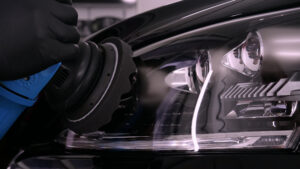
Not sure if your headlights are past the point of a simple clean? Here’s what to look for:
- Yellowing or amber tint — the lenses look visibly discolored rather than clear
- Hazy or foggy appearance — a cloudy film over the surface that won’t wash off
- Chalky texture — the lens surface feels rough or dull rather than smooth
- Reduced beam distance — your headlights don’t seem to illuminate as far down the road as they used to
- Age — if your vehicle is 5 years old or more and the headlights have never been restored, there’s a very good chance they need attention
A quick test: stand in front of your parked car at night and look at what the headlights actually illuminate. If the beam looks weak, yellowed, or scattered rather than a clean, bright white projection, restoration will make a noticeable difference.
Professional Headlight Restoration vs. DIY Kits
Walk into any auto parts store and you’ll find headlight restoration kits ranging from $10 to $40. They look like a simple solution. The reality is more complicated.
The problem with DIY kits:
Most consumer restoration kits include a basic abrasive compound and a small piece of sandpaper. They can remove surface-level oxidation and produce a temporary improvement — but they almost never include a quality UV-protective sealant or coating.
Without proper UV protection applied after restoration, the polycarbonate starts re-oxidizing almost immediately. Many drivers who use DIY kits find their headlights are hazy again within a few months. The issue isn’t the sanding — it’s the lack of durable protection at the end.
What professional restoration does differently:
Professional restoration uses a controlled, multi-stage sanding process with progressively finer grits, followed by machine polishing with professional compounds that achieve a much higher level of optical clarity than hand application. Most importantly, professional service finishes with a high-quality UV-resistant coating or clear coat that creates a durable barrier — lasting 1 to 3 years or more depending on your driving conditions.
The difference in longevity between a professional restoration with proper UV sealing and a basic DIY kit is substantial — and the cost difference is often smaller than people expect.
The Professional Headlight Restoration Process at Massachusetts Car Detailing
Here’s exactly what we do:
Step 1 — Inspection. We assess each headlight to determine the severity of oxidation and whether restoration is appropriate. In cases where the lens is cracked, deeply pitted, or has internal moisture damage, we’ll be upfront that restoration isn’t the right solution and that replacement should be considered instead.
Step 2 — Cleaning and masking. We thoroughly clean the lens surface and mask the surrounding paint and trim to protect them during the sanding and polishing stages.
Step 3 — Multi-stage wet sanding. Using a progression of sandpaper grits — starting coarser to remove the damaged oxidized layer and finishing finer to smooth the surface — we carefully sand the lens in controlled passes. Wet sanding minimizes dust and heat, keeping the process safe for the plastic.
Step 4 — Machine polishing. After sanding, we use a professional rotary or dual-action polisher with finishing compounds to remove the sanding marks and restore full optical clarity to the lens. This step is where the transformation happens — the headlight goes from dull and hazy to clear and glossy.
Step 5 — UV sealant application. The final and most important step. We apply a professional-grade UV-resistant sealant or clear coat to protect the restored lens from the UV radiation and environmental exposure that caused the oxidation in the first place. Without this step, the results won’t last. With it, you can expect the restoration to hold for 1 to 3 years with normal care.
The whole process typically takes about 45 minutes to an hour per vehicle — and the before-and-after difference is dramatic.
How Much Does Headlight Restoration Cost vs. Replacement?
This is where restoration becomes an obvious choice for most drivers.
New OEM headlight assemblies for a typical vehicle can range from $150 to over $600 per side — plus labor for installation. For some vehicles, a single headlight assembly can cost over $1,000.
Professional headlight restoration costs significantly less and delivers results that restore most of the original light output and clarity. For headlights that are oxidized but structurally sound, restoration offers dramatic improvement at a small fraction of the replacement cost.
The only situation where replacement makes more sense is when the lens has physical damage — cracks, deep pitting, or internal moisture fogging — that restoration can’t fix. We’ll always give you an honest assessment before any work begins.
How Long Does Headlight Restoration Last?
With a proper UV sealant applied, professionally restored headlights typically stay clear for 1 to 3 years. How long yours last depends on:
- Sun exposure — vehicles parked outdoors in full sun re-oxidize faster than those kept in a garage
- Driving conditions — frequent highway driving exposes lenses to more debris and UV
- Maintenance — applying a quality spray wax or UV protectant to your headlights periodically after restoration helps extend the results
When the clarity starts to fade, restoration can simply be performed again. Most drivers get several restoration cycles out of a set of headlights before replacement becomes necessary.
Headlight Restoration at Massachusetts Car Detailing
If your headlights are hazy, yellowed, or just not as bright as they used to be, bring your vehicle into our Rockland, MA shop. We’ll restore clarity, improve your safety, and have your car looking sharp again — all in under an hour.
We serve Rockland and the entire South Shore, including Weymouth, Hingham, Norwell, Hanover, Braintree, and surrounding communities.
320 Centre Ave, Rockland, MA (781) 347-5321 Open 7 days a week, 7AM–7PM
Book your headlight restoration appointment today →
Frequently Asked Questions
How much does headlight restoration cost in Massachusetts? Pricing depends on the condition of your headlights and whether one or both need restoration. Contact us at (781) 347-5321 for a quick quote — most jobs are very affordable compared to the cost of replacement.
How long does the restoration take? Most vehicles are done in 45 minutes to an hour. You can wait at our Rockland shop while we work.
Will my headlights look brand new after restoration? For most vehicles with oxidation-only damage, the results are dramatic — close to factory-new clarity. Headlights with physical cracks or internal damage won’t achieve the same result, and we’ll tell you that upfront.
How long will the restoration last? With our professional UV sealant, expect 1 to 3 years of clear results depending on your driving habits and how much sun exposure your vehicle gets.
Can you restore just one headlight? Yes, though we always recommend doing both at the same time. Mismatched headlights — one restored and one foggy — look noticeably uneven and create an imbalanced beam pattern at night.
Is headlight restoration worth it if my car is older? Absolutely. Foggy headlights are a safety issue regardless of the vehicle’s age. Even on an older car you’re planning to sell, restored headlights improve resale appeal and safety significantly for a very small investment.
Do foggy headlights affect my Massachusetts state inspection? Headlights are assessed as part of the Massachusetts annual inspection. While inspectors check that lights function, severely deteriorated headlights can draw scrutiny. More importantly, the safety case for restoration is strong regardless of inspection requirements.
Sources: AAA Newsroom — “AAA Illuminates the Dangers of Driving with Cloudy Headlights” (December 2018). Massachusetts Car Detailing serves Rockland, MA and the South Shore. All services performed at 320 Centre Ave, Rockland, MA.